Throughout my career as an emergency physician, entrepreneur, and investor, I’ve seen firsthand how difficult it is to bring new therapies to patients. Scientific breakthroughs often capture the headlines, but behind every successful treatment is an incredibly complex clinical development process—one that demands precision, regulatory rigor, and countless hours of highly specialized work.
One of the most important lessons I’ve learned is that healthcare innovation isn’t just about discovering the next breakthrough drug. It’s also about improving the systems that make those breakthroughs possible.
That’s exactly why we invested in Hill Research.
A hidden bottleneck in drug development
When people think about clinical trials, they typically picture patients, physicians, and researchers. Few realize that before a therapy ever reaches regulators, massive amounts of clinical data must be cleaned, standardized, analyzed, quality checked, and transformed into submission-ready reports.
This work falls within clinical biometrics—a highly specialized field that includes statistical programming, data standards, and regulatory reporting.
It’s essential work. It’s also incredibly manual.
Across pharmaceutical companies and contract research organizations (CROs), teams spend thousands of hours preparing clinical datasets, generating tables and figures, performing quality control, and ensuring every output meets strict regulatory requirements. Accuracy isn’t optional, and neither is documentation.
It’s exactly the kind of workflow where artificial intelligence has the potential to create enormous value—not by replacing experts, but by helping them work faster, more consistently, and with greater confidence.
Why Hill Research stood out
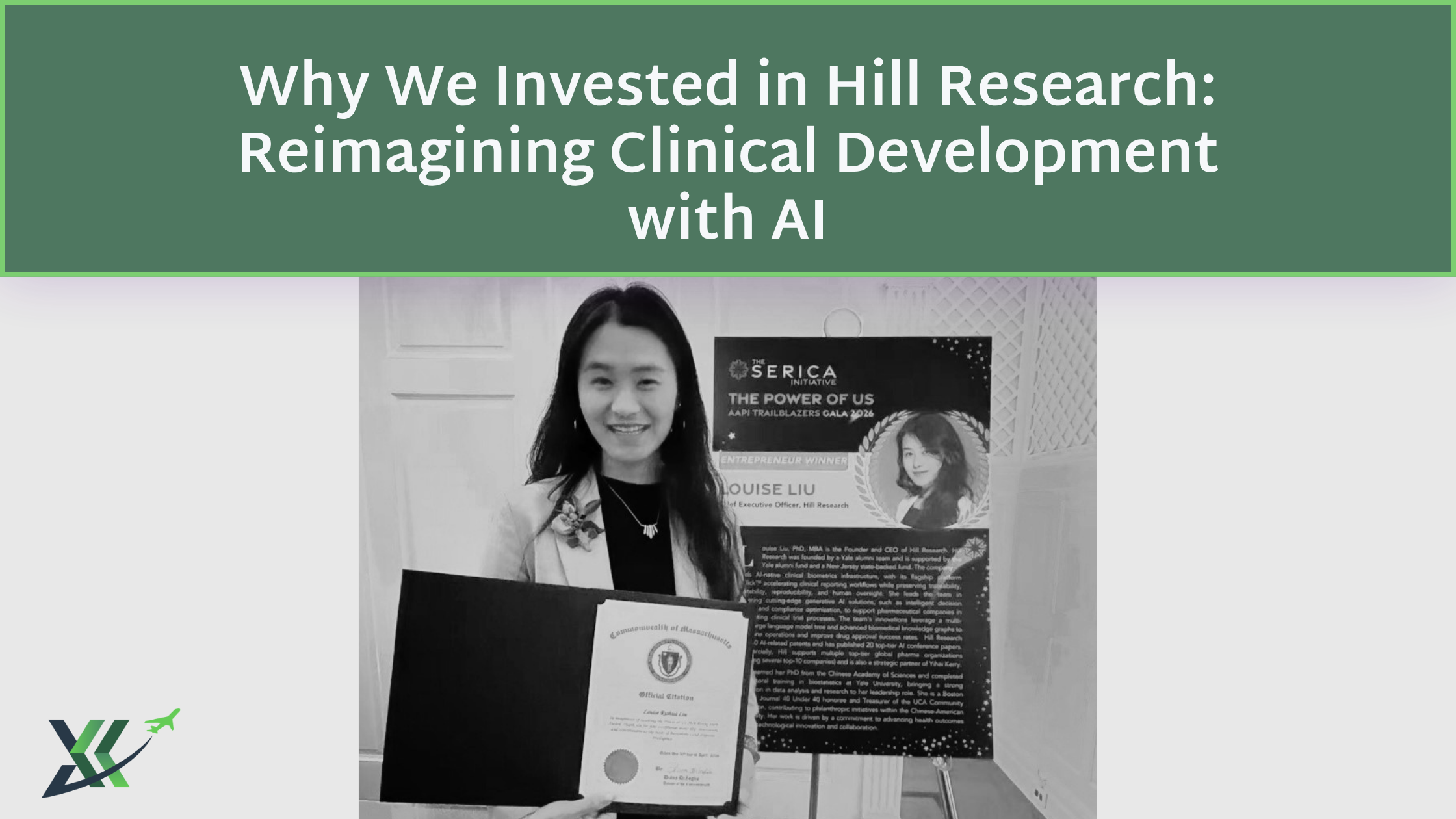
Founded in 2022 by Louise Liu, Hill Research is taking a fundamentally different approach to clinical biometrics.
Rather than simply layering AI onto an existing CRO model, the company is rebuilding the workflow itself.
Its platform, TriClick™, is an agentic, human-supervised AI system designed specifically for regulated clinical environments. The platform helps move clinical data through the statistical programming process—from SDTM and ADaM datasets to tables, listings, figures, quality control, and submission-ready outputs—all while emphasizing transparency, traceability, and regulatory compliance.
That distinction matters.
In healthcare, AI isn’t valuable simply because it’s fast. It has to be explainable. It has to be auditable. And it has to fit within regulatory expectations.
Hill Research understands that.
The founder matters
At Jetstream Venture Fund, we invest in people as much as we invest in technology.
Louise Liu is exactly the type of founder we look for.
She combines deep technical expertise with real commercial experience, bringing together a background in biostatistics, artificial intelligence, and healthcare. Her career spans successful AI ventures, significant transaction experience, and years spent solving complex technical problems at the intersection of science and business.
Just as importantly, she’s built a leadership team with meaningful expertise across machine learning, clinical trial operations, regulatory submissions, and pharmaceutical commercialization.
That combination gives us confidence that Hill Research understands both the technology and the industry it’s serving.
AI that works alongside experts
One of the biggest misconceptions about AI in healthcare is that it’s meant to replace experienced professionals.
The reality is much different.
The most impactful AI systems augment human expertise rather than eliminate it.
Hill Research’s vision reflects that philosophy.
TriClick™ operates as an intelligent teammate—automating repetitive programming tasks while keeping experienced biostatisticians and clinical experts in control. Human oversight remains central to the process, helping ensure that outputs are not only efficient but also accurate, compliant, and ready for regulatory review.
In highly regulated industries, that balance between automation and accountability is critical.
A significant market opportunity
Clinical development continues to become more data-intensive, while demand for experienced statistical programmers remains high.
Hill Research estimates that annual spending on biostatistical programming is measured in the tens of billions of dollars, yet AI adoption remains in its early stages.
As the industry looks for ways to shorten development timelines without compromising quality, we believe platforms that can automate repetitive implementation work—while preserving human judgment—will become increasingly valuable.
The opportunity isn’t simply to make today’s workflows faster.
It’s to fundamentally rethink how clinical data moves from study execution to regulatory submission.
Early validation
What also impressed us was the company’s early traction.
According to Hill Research, TriClick™ has already supported more than 50 clinical studies spanning oncology, immunology, and central nervous system disorders.
In one reported Phase III oncology program, the platform produced submission-ready tables, listings, and figures dramatically faster than traditional approaches while maintaining fully traceable outputs.
We believe those kinds of measurable improvements matter.
For pharmaceutical companies, every day saved during clinical development has meaningful implications—not only financially, but potentially for the patients waiting on new therapies.
Looking ahead
Hill Research has reported it is entering its next phase of growth with strong momentum, including significant customer interest and plans to expand both its technology platform and commercial reach.
While we’re encouraged by the company’s progress to date, what excites us most is the long-term vision.
The team isn’t building another AI tool.
They’re building an AI-native clinical biometrics platform designed for one of the most demanding environments in healthcare.
If successful, that platform has the potential to reshape how clinical data is prepared, analyzed, and submitted across the pharmaceutical industry.
Why we invested
At Jetstream Venture Fund, we look for companies addressing meaningful problems with differentiated technology, exceptional leadership, and clear market demand.
Hill Research checks each of those boxes.
The company is tackling a critical bottleneck in clinical development, bringing together artificial intelligence, regulatory expertise, and human oversight in a way that we believe can create lasting value for the life sciences industry.
We’re excited to partner with Louise Liu and the entire Hill Research team as they continue building what we believe could become a category-defining company in clinical AI.
Healthcare innovation isn’t only about discovering the next breakthrough therapy.
Sometimes, it’s about making every future breakthrough possible.
To get more updates on Hill Research as they unfold, you can follow their journey on LinkedIn and our Jetstream Venture Fund news section.