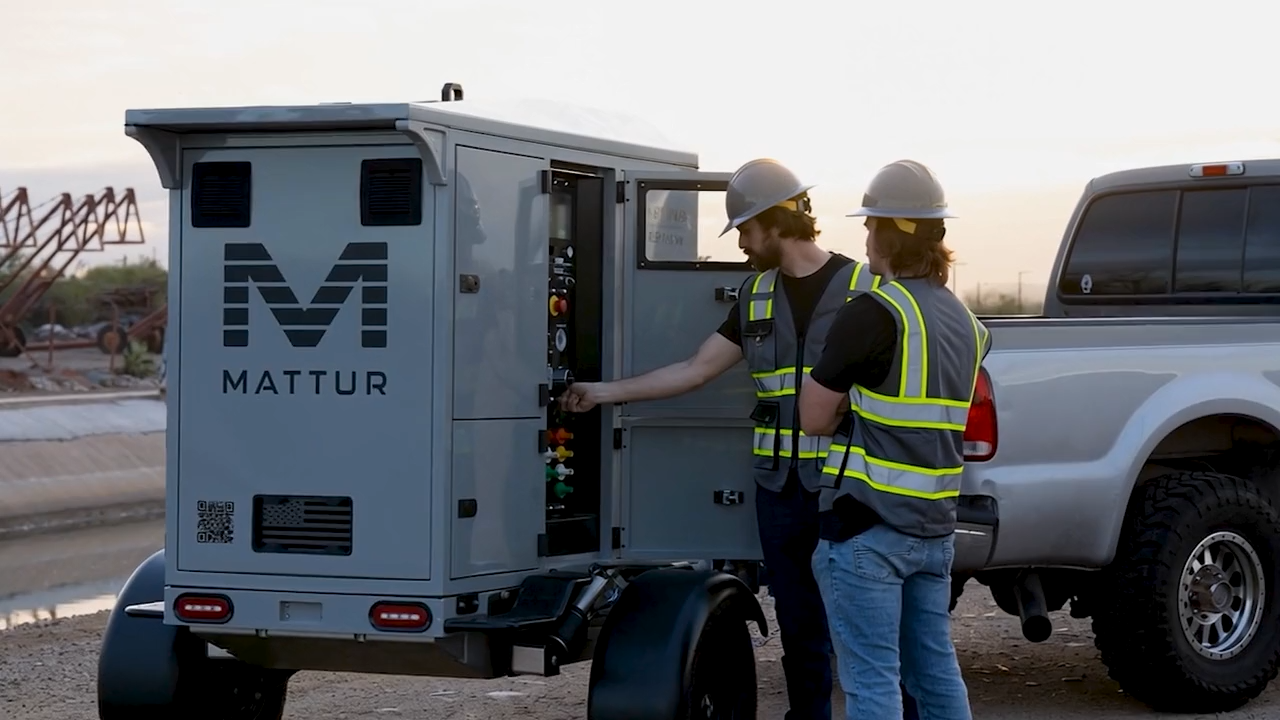
As America’s demand for electricity grows, the challenge isn’t simply producing more power. It’s delivering reliable, efficient electricity that can adapt to changing needs. The challenge, and Mattur’s solution are what caught our attention. First, we’ll share what’s different about their technology. You can skip to the end for our investment perspective.
Mattur, a Phoenix-based energy technology company, is developing a proprietary generator platform designed to serve three major markets: mobile power, backup power, and wind energy.
Rather than engineering an entirely different system for every application, Mattur is building around a shared technology architecture called PulseTech. The goal is to make power generation more flexible, improve operating efficiency, and simplify how equipment is manufactured, deployed, and maintained.
Jetstream Venture Fund is excited to welcome Mattur to its portfolio, backing an experienced team working to rethink a fundamental piece of modern infrastructure.
One technology platform. Three energy markets.
America’s electricity needs are growing. A June 2026 report from Lawrence Berkeley National Laboratory estimates that data centers alone could consume 11.8% of U.S. electricity by 2030 under its central scenario. Meanwhile, the U.S. Energy Information Administration projects record U.S. electricity generation in 2026.
Meeting that demand requires more than additional capacity. Businesses also need power systems that are dependable, efficient, and adaptable to different operating environments.
Mattur is pursuing that opportunity through a common generator architecture that can support multiple product lines. If successful, this approach could reduce engineering and manufacturing complexity while allowing improvements to its core technology to benefit several markets.
1. Mobile power: modular systems that adapt to demand
Construction sites, industrial operations, and equipment rental companies often need different amounts of electricity for different jobs. Traditional generators typically come in fixed capacities, which can leave customers managing multiple machine sizes or purchasing more capacity than they regularly use.
Mattur is developing a modular alternative built around standardized 20-kilowatt power modules. These modules can operate independently or be combined into larger configurations, with the company’s mobile power systems designed to scale to applications as large as 200 kW.
This architecture could allow customers to expand capacity without replacing an entire generator. Shared components may also simplify maintenance, technician training, and equipment management.
Mattur is pairing its modular design with variable-speed engines, intelligent controls, power electronics, and supercapacitors that help manage short bursts of high electricity demand.
The company estimates its systems could reduce fuel consumption by 20%–30% compared with conventional generators, depending on operating conditions, and advertises up to 2× surge capability. These are company-reported performance claims that require validation under relevant real-world conditions.
For customers, the potential value is straightforward: more adaptable power, less unnecessary capacity, and potentially lower operating costs.
2. Backup power: A shared foundation for reliable electricity
Mattur is applying its modular approach to backup power systems, with designs that can integrate generation, battery storage, and intelligent power management.
Backup requirements vary widely, from keeping essential residential appliances running to supporting critical commercial operations. A modular platform could help tailor systems to those needs without requiring a completely different underlying architecture for every installation.
The opportunity is not simply another backup generator. It’s the potential to reuse core technology across product lines, creating efficiencies in product development, manufacturing, and servicing as the business scales.
3. Wind energy: exploring lower-wind applications
Mattur is also developing wind turbine technology that combines its low-speed generator architecture with a diffuser-augmented rotor and Adaptix AI software.
The diffuser is designed to accelerate airflow through the rotor, while the generator architecture is intended to reduce the resistance needed to begin generating electricity. Mattur publishes a designed cut-in wind speed of approximately 2.0 meters per second, which could expand the range of locations suitable for wind generation if validated in commercial operating conditions.
In November 2025, the company’s CEO described a wind technology pilot at Matori Farms in Tonopah, Arizona, in public reporting.
The wind platform remains under development. Commercial performance, certification, durability, and economic viability will be important milestones as Mattur works to bring the technology to market.
Across all three applications, the central strategy remains the same: develop a common technology foundation and apply it to different power-generation challenges.
An experienced, Arizona-based team
Developing new power-generation hardware requires expertise across electrical engineering, mechanical systems, controls, manufacturing, and commercialization.
Mattur was founded by Kaleim Manji, CEO, and Kris Kesler, CTO. Manji brings experience leading and repositioning technology-driven businesses, while Kesler has more than two decades of advanced manufacturing experience. Before Mattur, Kesler founded Bobe, which developed more than 35,000 components across industries before its acquisition in 2018.
Mattur’s engineering team also brings experience from aerospace and defense organizations, including Blue Origin, Northrop Grumman, Orbital ATK, and General Dynamics. That background is relevant to the company’s focus on complex systems designed to operate reliably under demanding conditions.
The company has also attracted experienced business leaders. Its board includes David Tedesco, founder and CEO of Outlier; Tim Crown, co-founder of Insight Enterprises; and Jay Petkunas of The Wolff Company. In February 2026, Mattur announced a follow-on investment from Outlier and Tedesco’s appointment as chairman.
Mattur has also received U.S. Patent No. 12,476,517 B2, granted in November 2025, covering hollow magnetic flywheel and related generator systems.
Why Jetstream invested in Mattur
At Jetstream, we look for companies with differentiated technology, a meaningful market opportunity, and teams capable of turning innovation into a scalable business.
Mattur stood out for several reasons. Mattur’s shared generator platform combines modular capacity and demand-responsive technology to help customers improve power flexibility, fuel efficiency, and operating costs. By applying its core technology across mobile power, backup systems, and wind energy, the company has the potential to streamline manufacturing, expand into multiple markets, and scale its business—provided each product demonstrates performance, customer demand, and commercial viability.
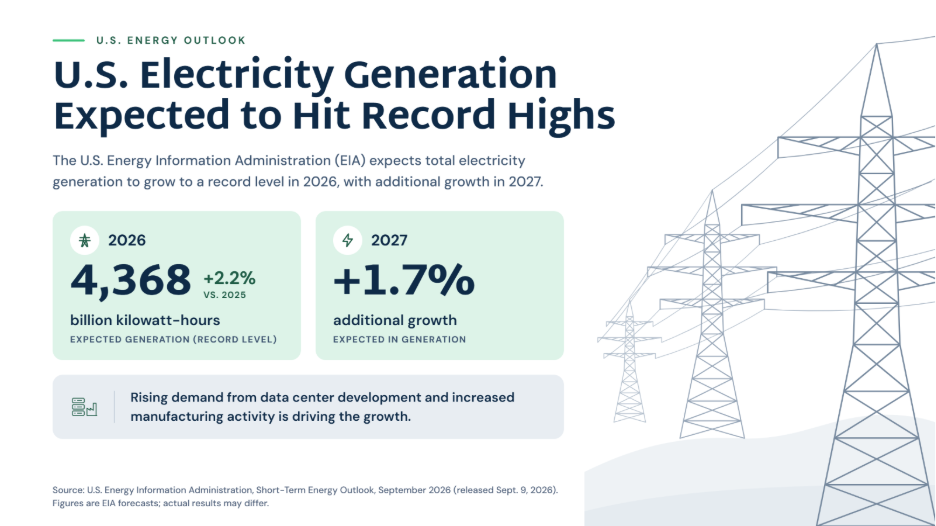
Figure 1*
As shown in the Figure 1, The U.S. Energy Information Administration projects that domestic electricity generation will reach a record 4,368 billion kilowatt-hours in 2026, a 2.2% increase over 2025, with another 1.7% increase expected in 2027. Much of this growth is being driven by rising electricity demand from data center development and increased manufacturing activity, underscoring the growing need for reliable, flexible, and efficient power solutions. This demand outlook is an important part of why we invested in Mattur: its generator technology is designed to address evolving power needs across mobile power, backup systems, and wind energy. As electricity demand continues to grow, we believe technologies that can improve how power is generated and delivered deserve attention—while recognizing that commercial adoption and real-world performance will ultimately determine their impact.
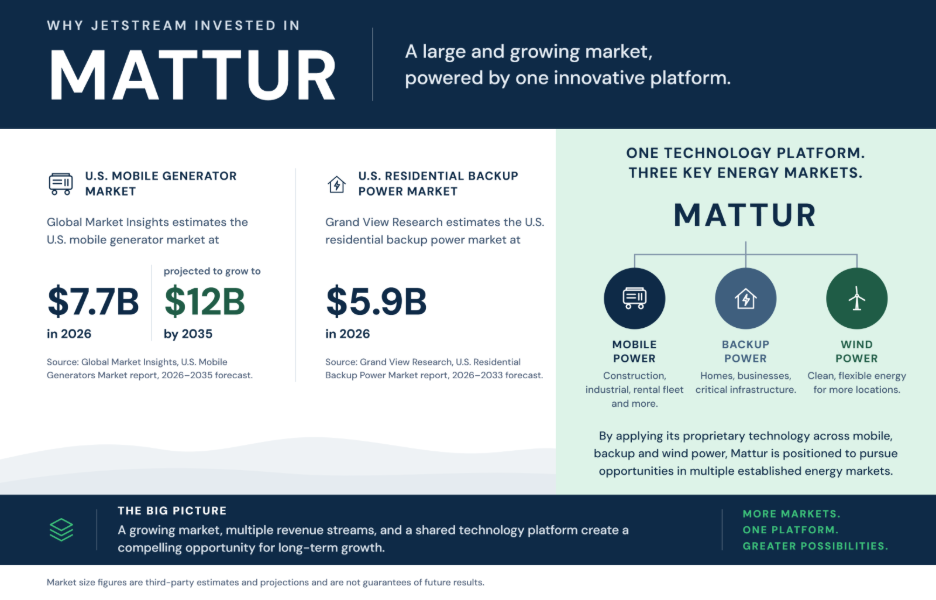
Figure 2**
The opportunity extends well beyond the growing demand for electricity. As shown in Figure 2, Global Market Insights estimates the U.S. mobile generator market at $7.7 billion in 2026, with projected growth to $12 billion by 2035. Meanwhile, Grand View Research estimates the U.S. residential backup power market at $5.9 billion in 2026. Mattur is developing one underlying technology platform for applications across mobile, backup, and wind power, positioning it to pursue opportunities in multiple established energy markets.
As an Arizona-based investment team, we’re particularly excited to support a local company bringing together advanced engineering, manufacturing expertise, and an ambitious approach to energy infrastructure.
What’s also notable from an investment perspective is that existing investors are increasing their commitment. Chairman David Tedesco joined the board alongside a follow-on investment from his company, Outlier. When an existing investor increases its commitment and takes the chair, it signals conviction from the people who know the company best.
We believe its combination of proprietary engineering, modular design, experienced leadership, and multiple potential applications makes Mattur a compelling addition to the Jetstream portfolio.
Powering what’s next
Electricity underpins nearly every major industry, and meeting tomorrow’s needs will require innovation in how power is generated and delivered.
Mattur is working to make power generation more adaptable by applying one underlying technology platform across multiple applications. If the company can translate that approach into reliable products and compelling customer economics, it could create meaningful opportunities across several energy markets.
We’re excited to support Mattur as it works to bring its technology to market.
Discover the companies building what’s next
Jetstream Venture Fund provides investors access to a professionally managed portfolio of private companies pursuing emerging technologies across energy, healthcare, aerospace, defense, artificial intelligence, and other industries.
If you’re curious how we select companies for our portfolio, please join our upcoming webinar on Nov. 16 at 1 pm MST. All registrants will receive a recording.
Explore the Jetstream portfolio, learn how the fund works, or schedule an informational call with Fund Manager Douglas Sylvester to learn more.
Investing in private companies involves significant risks, including the potential loss of principal. Past performance and projected market growth do not guarantee future results. Please review the fund’s offering documents for additional information about risks, fees, and investment terms.
*Figure 1 is AI-generated using data from www.eia.gov.
**Figure 2 is AI generated using data from Global Market Insights and Grand View Research