Photo Credit: Hill Research
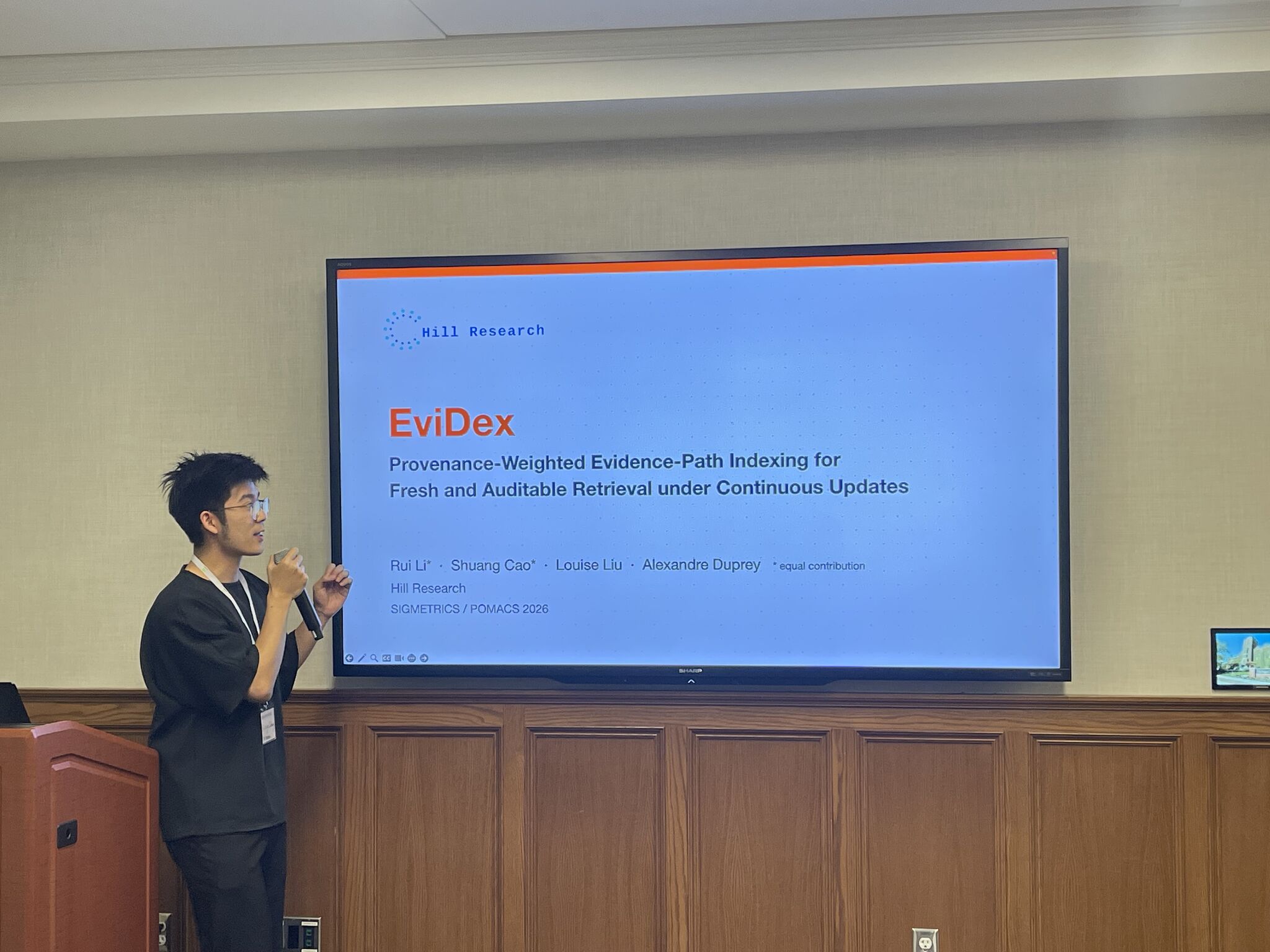
In the sixth episode of Hill Research’s AI on the Hill podcast, host Vivian speaks with Shuang Cao about EviDex, a retrieval system that treats freshness as part of correctness. Cao is co-first author of the EviDex paper presented at ACM SIGMETRICS 2026. She led the project at Hill Research with Rui Li before joining Apple and speaks in her personal capacity.
Why Freshness Belongs Inside the Definition of a Correct Answer
Most retrieval systems treat an answer as correct as of its snapshot and handle staleness separately. EviDex rejects that split. According to Hill Research, at a 15-minute horizon, 31.2% of time-sensitive clinical queries depend on evidence committed within that window, so a snapshot can produce a different answer entirely.
Instead of rebuilding a search index on a schedule, EviDex maintains a live map of the evidence. A new claim updates only the part of the map it affects, and every answer returns with the chain of sources and timestamps behind it.
The Language Model Is the Last Step
Cao argues that the hard work sits in retrieval and indexing, not in the language model. The model turns assembled evidence into a readable, cited answer, but it does not decide what counts as current. She closes with advice for any AI user: ask where an answer came from and how recently it was checked.
About Hill Research
Princeton, New Jersey-based Hill Research is an AI-powered clinical research company and a Jetstream Venture Fund portfolio company. Its TriClick™ platform applies the same traceability discipline to clinical trial biostatistics. An earlier episode covered Med-ICE, Hill Research’s multi-agent framework for medical AI reliability.
Frequently Asked Questions
What is EviDex?
EviDex is a retrieval system developed at Hill Research and presented at ACM SIGMETRICS 2026. It maintains a live map of evidence, updating only affected parts when new claims arrive, and returns each answer with its sources and timestamps.
Why does freshness matter for clinical AI?
Clinical decisions can depend on very recent evidence. According to Hill Research, 31.2% of time-sensitive clinical queries rely on evidence committed within the previous 15 minutes, so answers drawn from outdated snapshots may be wrong rather than simply older.
Read the Original Article: Podcast: EviDex, Chasing the Truth Before It Expires